
Glass edge thermal conductivity plays a crucial role in the overall thermal performance of windows because it represents a significant thermal bridge.This article will analysis the vacuum insulating glass edge thermal conductivity.
Table of Contents
The windows overall U value is decided by three factors:
Uw = ΣAf×Uf+ΣAg ×Ug+ Σψg ×Lg Ag +Af
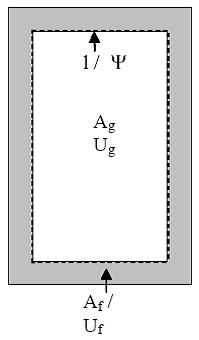
windows overall thermal conductivity
Remark:
Uw —windows overall thermal conductivity W/m2·K
Ug —Glass U value W/m2·K
Ag —Glass area m2
Uf —windows frame U value W/m2·K
Af —windows frame area m2
Lg —glass edge linear perimeter m
Ψg —glass linear edge thermal conductivity W/m·K
From above formula we can get conclusion:
1.As glass area account usually 80% of total windows area,the U value of glass is key point deciding the final windows U value.
2.Windows frame account only 20% of total windows area and the extra costs to enhance windows frame U value is difficult and high.
3.Linear edge thermal conductivity of glass is the 3rd key point deciding windows overall thermal property.That’s the reason why warm edge spacer was invented to control the heat loss through glass edge,the result can be 0.1-0.3W/m2.k.
While the center of a double or triple-pane glazed unit benefits from the insulating properties of the gas fill (argon, krypton, or air) between the panes, the edges where the glass panes are joined and sealed often have a higher thermal conductivity. This is typically due to the materials used for the spacer bar (e.g., aluminum, which is highly conductive) and the sealant. Heat can readily bypass the insulating gas layer and transfer directly through these more conductive edge materials. This phenomenon, known as the “edge effect,” leads to increased heat loss in winter and heat gain in summer, causing condensation issues and impacting the window’s overall U-factor or R-value. Therefore, minimizing glass edge thermal conductivity through the use of “warm edge” spacers made from less conductive materials (like stainless steel, composites, or foam) is essential for improving the energy efficiency and comfort performance of modern windows.
Technoform developed warm edge spacer and shows the importance of spacer in decreasing windows U value.
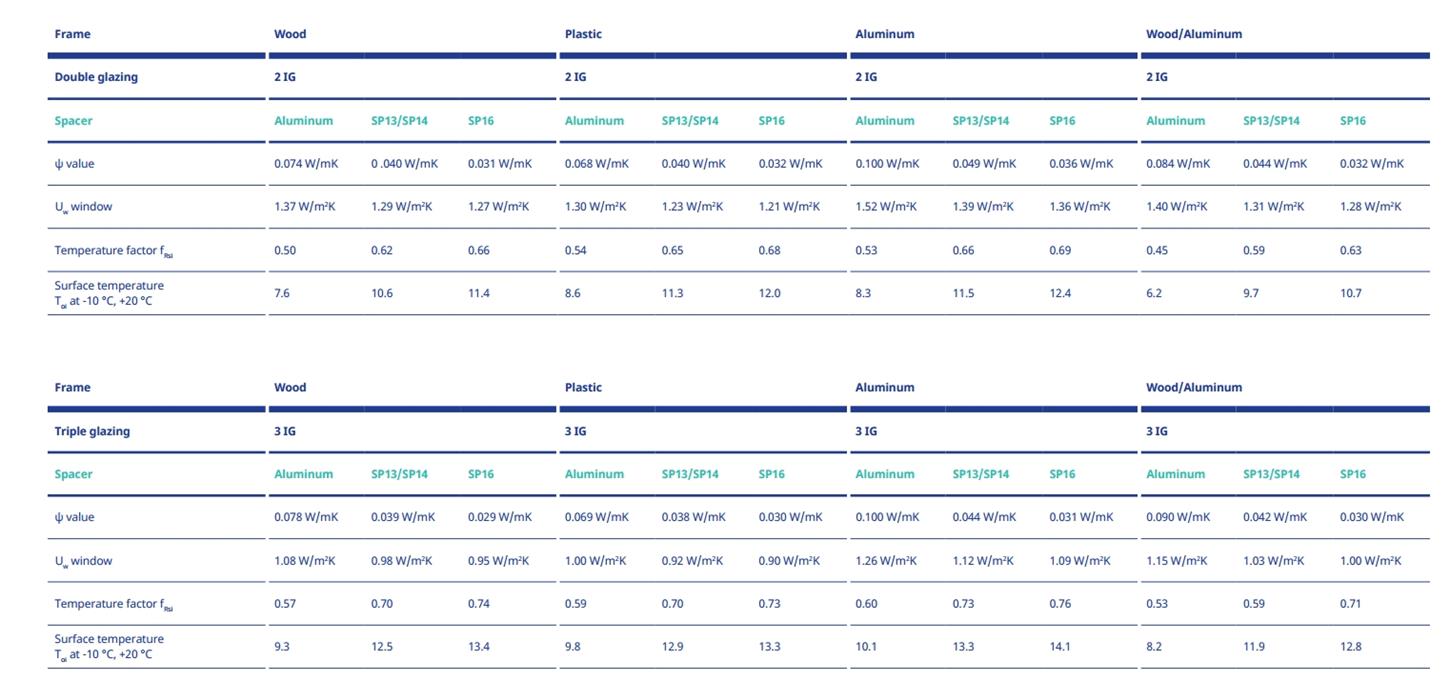
Technoform warm edge spacer linear edge thermal conductivity
Vacuum insulating glass edge thermal conductivity
Traditional insulating glass,whether double glazing or triple glazing has very clear ψ value to calculate the windows U value,but how about vacuum glazing?
Even though vacuum glazing has very excellent center thermal conductivity,and when further been processed into hybrid VIG,the glass thermal conductivity can be reduced to 0.3W/M2.K.But in some heritage buildings that don’t allow thick HVIG,single VIG glazing still has big disadvantage in edge thermal conductivity.Then how big affect is that?
To get this clear,we need to know the edge thermal conductivity of vacuum glazing.
The formula to calculate insulating glass U value: 1/U =R+ 1/He+1/Hi
In this formula- R= Glass heat resistance ,(m ·K)/W;
He =Exterior Surface heat transfer coefficient,W/(m2·K)
Hi -Interior Surface heat transfer coefficient,W/(m2·K)
According to GB/T 22476=2008, He is 23W/(m2·K),Hi is 8W/(m2·K)
After sealing, the edges of vacuum glass are connected to form a whole. To calculate the heat transfer coefficient of the edges of vacuum glass, we can assume that the entire surface of vacuum glass is made of two pieces of glass welded by solder, and the edge width is infinite. Based on the above assumptions, it can be seen from formula (1) that the heat transfer coefficient of the welded part of vacuum
1/U edge =R edge +1/He +1/Hi
In this formula, U edge is VIG edge part U value, R edge =edge heat resistance =R glass +R sealing materials. R glass =D glass /λ glass
R sealing materials =D materials/ λ materials. λ glass =1 W/(m·K);
R sealing materials, glass solder = 1 W/(m·K),metal alloy =67 W/(m·K)
So 1/U edge =D glass /λ glass +D materials/ λ materials + 1/He +1/Hi, Let’s take HaanGlas Basic 10.15mm glass as example,
Then HaanGlas Basic VIG edge thermal conductivity is
1/U edge =0.00015/ 1 +0.01/ 1+ 1/23 +1/8 =0.17862826
U edge =5.5982W/M2.K
Another HaanGlas Pro VIG edge thermal conductivity is
1/U edge =0.00015/ 67 +0.008/ 1+ 1/23 +1/8 =0.1764804988
U edge =5.66634W/M2.K
From above formula and calculation,we can see that the edge U value is decided mostly by the glass heat transfer coefficient, VIG sealing materials plays very very small function and has very limited effect on the final U value.
The edge sealing part only occupies a small part of the vacuum glass surface. When the sealing width is the same, the difference between the two edge sealing materials has a negligible impact on the overall heat transfer performance of the vacuum glass.
The effect of vacuum glazing linear edge thermal conductivity on finished windows
Based on above data,HaanGlas conducted some simulation ,including build model in Therm software ,and got below reference ψ when applying vacuum insulating glass in different windows frames.
| ψ | Wood | Aluminium | Wood/Alu | PVC |
| VIG | 0.075 | 0.087 | 0.08 | 0.07 |
| HVIG | 0.061 | 0.072 | 0.062 | 0.064 |
Conclusions:
(1) The difference in edge sealing materials has little effect on the heat transfer performance of vacuum glazing. when vacuum insulating glass with different edge sealing materials and the same edge sealing width is used with window frames, there is basically no effect on the linear heat transfer coefficient at the joint between the window frame and the glass, and the heat transfer coefficient of the whole window is basically the same.
(2) The edge sealing width has a greater impact on the heat transfer of the edge of vacuum glass. Regardless of the edge sealing material, the thermal insulation performance of vacuum glass with an edge sealing width of 8 mm is better than that of vacuum glass with an edge sealing width of 14 mm.
(3)During the production process, vacuum glazing manufacturers can reduce the edge width of vacuum glass as much as possible while ensuring the edge quality to improve the thermal insulation performance of vacuum double glazing, better reduce the heat transfer coefficient of glass windows, and reduce the linear heat transfer at the junction of window frames and glass, which can effectively improve the condensation problem at the edge of window frames and create a better living environment.

Leave A Comment
You must be logged in to post a comment.